
You just got a Snap. Someone replied “HY!” and now you’re staring at your screen like you’ve received a message in ancient Sumerian. Relax. It’s not complicated.
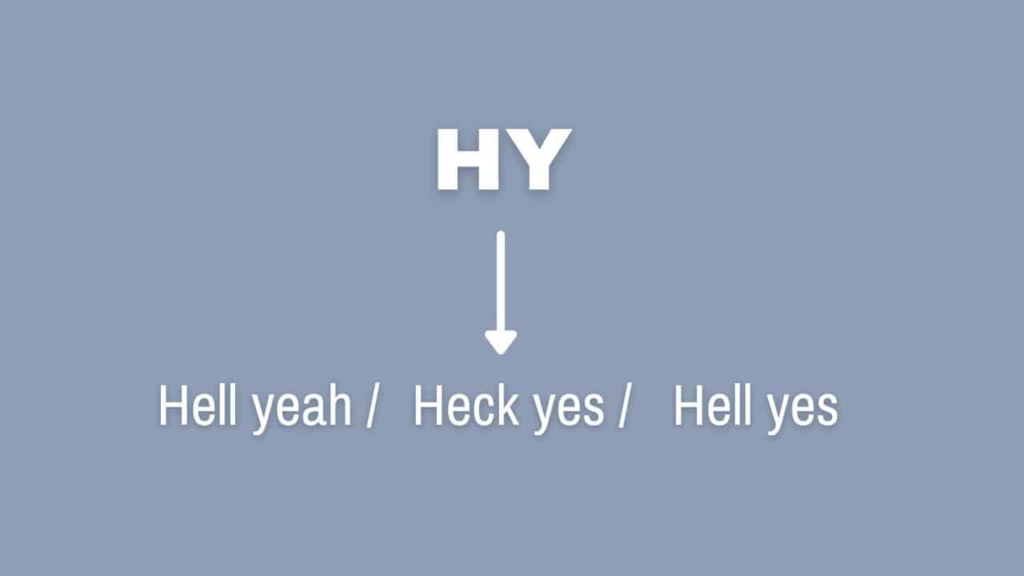
On Snapchat and other social media platforms, “HY” typically stands for “Hell Yeah” or “Hell Yes.” It’s a lively abbreviation that conveys excitement and enthusiastic agreement. Think of it as a turbocharged version of a regular “yes” — one that says “I’m not just agreeing, I’m pumped about this.”
So if your friend asks “Wanna grab pizza tonight?” and you get back “HY!”, that person is not mildly interested. They are ready.
Why Snapchat Has Its Own Language
Before we go deeper, it helps to understand why these two-letter codes even exist.
Snapchat had 946 million monthly active users in Q4 2025, up 6% year-on-year. With nearly a billion people firing off messages every day, brevity became a survival skill. Nobody wants to type “Yes, absolutely, I am very enthusiastic about this plan” when two letters get the job done.
48% of Snapchat users in the U.S. are between 15 and 25 years old. That demographic invented speed-texting. They also invented most of the slang that leaves the rest of us quietly Googling things at 11pm.
Snapchat’s format makes this even more pronounced. Messages disappear. Snaps are quick. Since Snapchat encourages fast, casual conversations, HY is a natural fit. It cuts through the noise with exactly two characters.
What HY Actually Means
Here’s where it gets slightly more nuanced, because “HY” isn’t locked to one meaning.
1. Hell Yeah / Hell Yes (Most Common)
This is the primary meaning on Snapchat. “HY” stands for “Hell Yes.” It’s a quick and enthusiastic way to express agreement or excitement on Snapchat.
Think of it as a more extreme and casual way than just “yes,” indicating the person is super excited. The “hell” part isn’t really about anything dark — it’s intensifying the agreement, the same way “absolutely” is stronger than “sure.”
2. Heck Yeah (Milder Version)
For those who prefer to keep things PG, “HY” can also mean “Heck Yeah” — providing the same level of excitement and agreement, minus the profanity. Same energy, cleaner language.
3. Hi / Hey / Hey Y’all (Casual Greeting)
Less commonly, HY can also be a cute way to say “hi” or “hey y’all,” especially when you want a friendlier greeting in a group chat with strangers.
So context matters here. “HY!” at the start of a conversation probably means “Hey!” But “HY!” after “Are you coming tonight?” definitely means enthusiasm.
How to Use HY on Snapchat (With Real Examples)
Using it wrong is worse than not using it at all. Here’s a practical guide.
When plans come together:
Friend: “Road trip this weekend?” You: “HY! What time are we leaving?”
When you agree with someone’s opinion:
Friend: “That new season was actually fire.” You: “HY it was, I binged the whole thing.”
When you want to open a group chat:
You: “HY everyone, who’s free Saturday?”
For example, on Snapchat, where messages and photos are transitory, a short “HY” can quickly convey to a friend that you are delighted with what they have posted. It cuts through the platform’s brevity, delivering a powerful punch with only two letters.
When NOT to Use HY
This is the part people skip, then regret.
If the topic is serious or sombre, using “HY” may appear inappropriate. Before using informal slang, make sure to consider the tone and context.
Replying “HY!” to someone sharing difficult news is not a vibe anyone wants. Neither is using it with a boss, a teacher, or anyone you need to take seriously. Knowing when to use slang terms is crucial, and it’s always best to consider the relationship you have with the person you’re texting.
Also, avoid it with people outside your age group or social circle who may simply not know what it means. Communication only works when both sides understand it.
HY on Other Platforms — Is It the Same?
Snapchat didn’t invent this acronym. The acronym can be found in text messages and DMs on apps like Snapchat, Instagram, WhatsApp, and more. However, it’s most commonly used on Snapchat, where there are several stickers and GIFs you can send to someone to better represent the sentiment.
HY on Instagram means “Hi,” “Hey!” or “Hell Yes.” People use it when they want to talk to someone, writing “Hi” or “Hey” to start a conversation.
So the core meaning travels across platforms, but Snapchat’s sticker and GIF ecosystem makes it feel most at home there.
How to Send an HY Sticker on Snapchat
Snapchat takes HY beyond plain text. You can send dedicated stickers that visually express the sentiment.
Visit your Snapchat account and use Snap’s camera to capture a photo. Move towards the right side of the panel and tap on the “Stickers” button. Using the search function, enter “Hell Yea” and you can see all the listed stickers as well as Bitmoji which seem relevant to the acronym. Choose any of them which you like and add it to your snap.
It’s a small detail, but it adds personality. A plain “HY” is enthusiastic. An HY Bitmoji sticker? That’s a whole different level of commitment to the bit.
Other Snapchat Slang You Should Know
Since you’re here, let’s expand your vocabulary. You don’t want to know what HY means but then get stumped by everything else.
Here are a few other commonly used Snapchat terms: Streaks — maintaining a streak of sending Snaps back and forth with someone for consecutive days. Tea — gossip or juicy information. Snap Score — a number that represents how active you are on Snapchat, based on the number of Snaps you’ve sent and received.
A few more worth knowing from the community:
- SMH — Shaking My Head (used to show disbelief or mild disapproval)
- TTM — Talk To Me (an invitation to start a conversation)
- NGL — Not Gonna Lie (used before an honest or blunt statement)
- WYD — What You Doing (a classic, timeless check-in)
Once you’ve got these down, you’ll navigate Snapchat conversations without needing a translation dictionary beside you.
Why Slang Like HY Matters More Than You Think
This isn’t just about keeping up with Gen Z, though that’s a perfectly valid reason. The use of acronyms has gained immense popularity among Snapchat users. Such slangs help you convey your message in a way that is easier to read and understand in the shortest possible time.
Language has always evolved with communication technology. The telegraph had its shorthand. Early SMS had character limits that forced abbreviations. Snapchat’s ephemeral format took that further. The rise of internet slangs poses challenges for language educators in terms of determining its place within language curricula. As the digital community evolves, internet slang will undoubtedly continue to play a pivotal role in shaping the linguistic landscape.
Whether you see this as exciting or alarming probably depends on your age. Either way, it’s happening.
Quick Reference: HY at a Glance
| Meaning | Context |
|---|---|
| Hell Yeah / Hell Yes | Excitement, strong agreement |
| Heck Yeah | Same as above, milder tone |
| Hi / Hey / Hey Y’all | Casual greeting, usually in groups |
Final Thoughts
HY is two letters doing the work of a dozen. It’s efficient, expressive, and — used correctly — one of those small touches that makes digital conversation feel more human, not less.
As language evolves within digital spaces like Snapchat, staying updated helps maintain engaging interactions with friends online. So next time someone throws a question your way filled with potential adventures ahead — don’t hesitate, just hit them back with an enthusiastic “HY!”
And if you’re still not sure whether to use it? Ask yourself: am I excited? Do I strongly agree? Is this a casual conversation with someone who gets it?
If the answer to all three is yes — then HY, go ahead.
Related reading from DotDaily:
- What Is an Insider Threat? Cyber Awareness 2025
- 192.168.1.1 — What Is It and How Does It Work?
- Aniwave: Everything You Need to Know
Sources:

Shahid Maqsood is an Editor and Content Strategist with 5 years of experience in digital media and content publishing. He holds an MBA and a Master’s degree in Mass Communications, combining business insight with editorial expertise. Shahid specializes in biography writing, technology, and business news — crafting content that is accurate, well-researched, and reader-first. He currently leads editorial strategy at Dot Daily, ensuring every story meets the highest standards of clarity and credibility. Connect on LinkedIn