
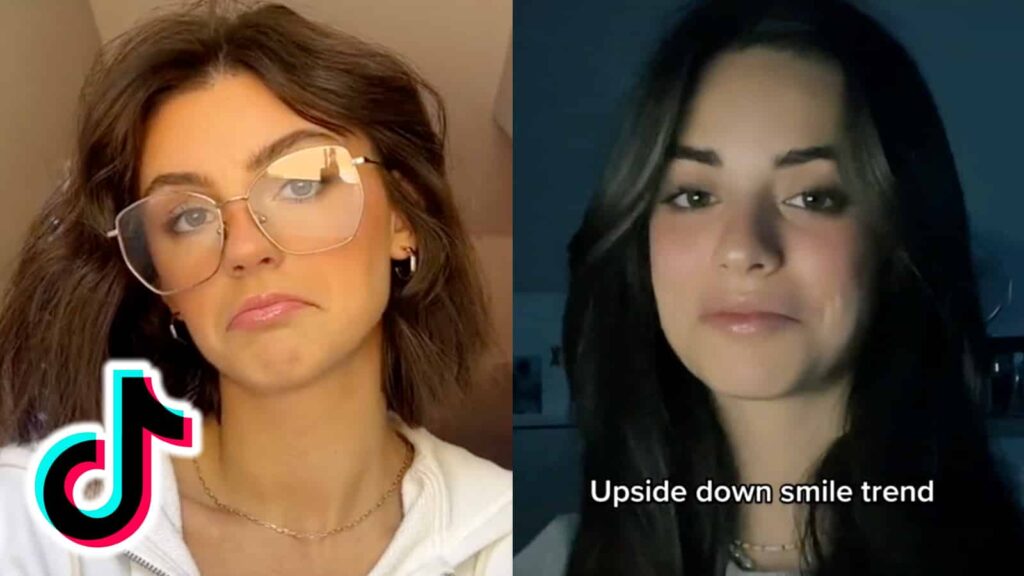
TikTok has given us a lot of strange things — viral dances, sea shanties, oddly satisfying cooking clips. But now it’s made us question something most of us thought we had completely figured out: our own faces. Enter the upside down smile trend — and no, it is not nearly as simple as it sounds.

TikTok is the birthplace of some of the internet’s most unexpected trends. The upside down smile is squarely among them.
What Exactly Is the Upside Down Smile?
The upside down smile — also called the downward smile or downturned smile — is a facial expression where the corners of your mouth curve downward, the way they would in a frown, but your face somehow still reads as a genuine smile. Think of the 🙃 emoji, then imagine a real human being doing exactly that with their actual face.
It sounds like a paradox. A frown that is also a smile? That is the kind of expression your brain initially refuses to process. But when people pull it off well, the result looks oddly charming — even attractive. When they cannot do it, the results are absolutely, chaotically hilarious. And that right there is precisely why the internet fell head over heels for it.
Quick definition: The upside down smile is achieved by smiling broadly while keeping the corners of your mouth pulled downward rather than upward. Cheeks engage, eyes may crinkle — but the mouth curves the wrong way. It looks strange in theory and somehow works brilliantly in practice.
Where Did the Upside Down Smile Trend Actually Start?
Like most genuinely great things on the internet, this trend has surprisingly specific origins. According to Know Your Meme, the upside down smile trend first emerged on Filipino TikTok in May 2022. Early videos showed creators showcasing their natural downward smiles, often in a warm and self-aware way.
On 16 May 2022, Filipino TikToker @kyleespammmlabyu posted a video captioned “you are beautiful” and reacted to it with an upside down smile expression. That video got over 370,000 views within three weeks. A day later, @sixxtnth posted a clip captioned “cute downward smile” that pulled more than 1.8 million views in a comparable timeframe.
The momentum was unstoppable from there. By late May 2022 the trend had crossed from Filipino TikTok into English-speaking creator communities worldwide. By early June 2022 it was receiving dedicated media coverage, with millions of people asking themselves one very urgent question: wait, can I actually do this?
📌 Key Timeline
- 16 May 2022 — First notable upside down smile videos appear on Filipino TikTok
- Late May 2022 — Trend spreads to English-speaking TikTokers across the globe
- Early June 2022 — Major media coverage begins; millions of views accumulate
- 2024 – 2026 — Trend resurges repeatedly as new waves of users discover it
How Do You Actually Do the Upside Down Smile?
Here is where things get tricky. The upside down smile is not something everyone can just casually do on command. A significant part of the trend’s charm is watching people attempt it and either nailing it perfectly or producing something that looks more like they have just tasted an extremely unexpected lemon.
The technique involves frowning — pulling the corners of your mouth downward — while simultaneously smiling. When done correctly, the result is a genuinely inverted smiley face expression. Cheeks lift, eyes crinkle at the edges, but the lips curve downward rather than up.
As GINX TV reported, some TikTokers find the expression surprisingly easy to pull off, while others find it nearly impossible. That gap between the two groups is exactly what makes it such effortlessly shareable content. Nobody is scrolling past a video where someone’s face does something completely unexpected.
The Science Behind the Downward Smile
Here is where it gets genuinely fascinating. Some people have a natural downturned smile — it is not a forced party trick for them at all. It is simply how their face works. And there is real anatomy behind it.
The key muscles involved in smiling include the zygomaticus major and zygomaticus minor, which pull the corners of your mouth upward. Opposing them is the depressor anguli oris, which pulls the corners of your mouth downward. In people who naturally have a downturned smile, the depressor anguli oris tends to be more dominant — either through genetics, habitual expression patterns, or the way signals travel through the facial nerve (cranial nerve VII).
So if someone’s face naturally curves downward while smiling, it is not sadness. It is anatomy. Which is — once you know that — completely endearing.
“I think it’s funny cause I smile like this naturally and now it’s a trend.”
— TikTok comment with over 6,000 likes, documented by Dexerto
Comment sections across the trend filled with similar sentiments — people saying things like “POV: you’ve been doing the upside-down smile wayy before the trend.” It is that rare social media moment where something you have quietly felt self-conscious about suddenly becomes a viral sensation. The internet is occasionally a wonderful place.
Why Did This Trend Go So Massively Viral?
TikTok trends do not go viral by accident. There is usually a specific combination of factors that pushes something from a niche corner of the platform onto everyone’s For You page. The upside down smile hit several of those buttons simultaneously.
1. It is a challenge — but a truly accessible one
Unlike dance trends requiring coordination or cooking trends requiring actual ingredients, this one only needs a face. Everyone has one of those. And yet not everyone can do it, which creates immediate personal investment. “Can I do this?” is one of the most clickable questions in the entire history of social media content.
2. Both outcomes produce great content
People who nail the upside down smile look unexpectedly magnetic. People who fail at it look gloriously unhinged. Both outcomes are brilliantly shareable. There is genuinely no losing scenario — which is extremely rare for a challenge format.
3. It pulls others in naturally
The trend spread rapidly through duets and stitches. Many creators filmed themselves alongside friends and family attempting the expression together, turning it into a social event rather than a solo performance. GINX TV noted how the group dynamic extended the trend’s reach significantly beyond what solo participation alone could have achieved.
4. It has remarkable staying power
The upside down smile trend does not stay gone. After its initial 2022 peak, it resurfaced throughout 2024 and again in 2025 and 2026 as new users encountered it. TikTok’s engagement-driven algorithm surfaces content based on interaction rather than publication date — meaning genuinely interesting content can return to feeds years after it first appeared.
The Upside Down Smile and Body Confidence
Here is the layer to this trend that gets a bit more meaningful. For many people, having a naturally downturned smile was a source of genuine self-consciousness. A resting expression that curves downward can make someone appear sad or unapproachable even when they feel completely happy — and plenty of people have quietly struggled with that for years.
The viral rise of the upside down smile reframed all of that. The expression went from perceived flaw to celebrated aesthetic almost overnight. Comment sections filled with people saying they had always quietly disliked their downward smile — and that watching this trend made them feel genuinely seen for the first time.
Social media deserves plenty of criticism for how it affects body image. But moments like this one — where a natural quirk becomes something cool rather than something to fix — are genuinely worth celebrating.
Worth noting: TikTok has seen various facial expression trends go viral over the years — including the shook filter and crying filter imported from Snapchat. The upside down smile stands apart because it requires no filter at all. It is just a face, doing something wonderfully unexpected.
Is the Upside Down Smile Trend Still Going in 2026?
Yes — and that longevity says something interesting about how TikTok actually operates. A trend that launched in May 2022 is still generating content, still pulling in new participants, and still appearing on For You pages years later. That is a genuinely impressive shelf life for internet content.
The #upsidedownsmile hashtag continues to accumulate millions of views. Creators post reaction videos, tutorials, duets comparing natural downward smilers to people attempting it for the first time, and longer commentary videos exploring what the expression communicates emotionally and psychologically.
This staying power is not unique to this trend specifically — TikTok’s algorithm promotes content based on engagement signals rather than publication date — but it does confirm that trends touching on genuine human curiosity around identity and self-expression tend to outlast anything purely novelty-driven.
Final Thoughts
The upside down smile trend is one of those delightfully odd internet moments that grows more interesting the longer you look at it. On the surface, it is people pulling funny faces at their phones. Underneath, it is a celebration of facial diversity, a challenge format with genuinely universal appeal, and a rare social media moment that left some people feeling better about themselves rather than worse.
It started on Filipino TikTok in May 2022, spread globally within weeks, and has since proven it has extraordinary staying power. Whether you can do the upside down smile effortlessly or your attempt looks like someone delivered very bad news mid-laugh — the content writes itself either way.
And in 2026, that kind of simple, joyful, slightly chaotic energy is genuinely something the internet could use more of.
Want more TikTok trend breakdowns explained in plain English? Browse more on Dot Daily’s TikTok coverage — we keep it real, readable, and actually useful.
Sources & References
- Know Your Meme — Upside Down Smile Trend — documented origin timeline and spread history (May 2022)
- Dexerto — What is TikTok’s viral upside down smile trend? — community response and comment data
- GINX TV — What Is The Upside Down Smile Trend On TikTok? — challenge mechanics and virality context
- TikTok — #UpsideDownSmile discover page — active trend data and ongoing community content
- Quizlet — Muscles of Facial Expression flashcards (anatomy context referenced in TikTok community discussion on cranial nerve VII and zygomaticus muscles)
